Your cart is empty

A Gift with a Genuine Stone: How to Choose Jewellery That Lasts for Generations
Perfume gets used up and a sweater fades over time. A piece of jewellery with a natural stone can be passed down. But for a gift to truly last, choosing a pretty colour is not enough. It depends on how durable the stone is, what metal it is set in, what size it should be and whether it is genuinely natural. We go through it step by step and, for each price level, show specific pieces from our range.
A gift that has no twin
Most of the jewellery in our range exists as a single piece. With stones, this makes sense: each crystal formed under different conditions and therefore has a different shade, different inclusions and a different play of light. Two rings with the same name therefore never look exactly alike.
For a gift, this is both an advantage and a commitment. An advantage because the recipient gets something no one else has. A commitment because the chosen piece cannot simply be “exchanged for the same one in a different size”. It is therefore worth being clear about a few practical things before you buy.
Three questions before you start choosing
1. Will the jewellery be worn every day, or on special occasions? The ring is the most sensitive to the answer. Hands bump into everything, so an everyday ring needs a durable stone. A necklace or earrings are under much less strain and can therefore handle more delicate materials too.
2. Does the recipient tend to wear silver or gold? Look at the jewellery they already wear. The warm tones of yellow gold and gold-plated silver look different from cool white silver, and most people stick to one of them.
3. What colour do they wear? Do not look for a “birthstone” or a “zodiac stone”, but for a colour that appears in their wardrobe. A deep wine-red garnet goes with dark, classic colours. A blue sapphire or aquamarine suits grey, white and navy blue.
Durability: which stone can handle everyday wear
The hardness of a stone is given on the Mohs scale from 1 to 10. It expresses resistance to scratching. Dust in the air contains quartz with a hardness of 7, so stones below this threshold can gradually become scratched and dull with everyday wear. The second property is toughness, i.e. resistance to chipping and cracking. It is not necessarily related to hardness: diamond is the hardest natural material, but a sharp blow in the right direction can chip it.
| Stone | Hardness (Mohs) | Suitable for an everyday ring? |
|---|---|---|
| Diamond | 10 | Yes |
| Sapphire, ruby | 9 | Yes |
| Topaz | 8 | Yes |
| Aquamarine, morganite | 7.5–8 | Yes |
| Emerald | 7.5–8 | Yes, but with caution: it usually has many fissures and inclusions and is less tough |
| Garnet | 6.5–7.5 | Mostly yes |
| Tanzanite | 6–7 | Rather for occasional wear |
| Moonstone | 6–6.5 | Rather for occasional wear |
| Opal | 5.5–6.5 | Better as a pendant or earrings |
| Turquoise | 5–6 | Better as a pendant or earrings |
| Pearl | 2.5–4.5 | Necklace and earrings |
This does not mean that an opal or tanzanite ring is a bad choice. It is just good to know that it is not suitable for gardening or the gym, and to tell the recipient so when you give it.

Choosing by budget
The prices given correspond to our current range. As these are mostly one-of-a-kind pieces, specific items of jewellery can sell quickly.
Up to CZK 5,000: a smaller stone, a fully fledged piece of jewellery
At this level, you will most often find jewellery in 925/1000 silver, sometimes partially gold-plated, with smaller stones. It is not worth chasing size here. It is better to choose a smaller stone of good quality than a large piece of unremarkable colour.
- Moonstone earrings for CZK 790: 6 × 6 mm cut stones in 925/1000 silver. Moonstone has a characteristic bluish-white sheen that shifts beneath the surface depending on the viewing angle. Its technical name is adularescence.
- Bracelet of cut garnets for CZK 990: beads approximately 3–3.5 mm in diameter strung on a metal wire, gold-plated silver and a lobster clasp. It also goes well with a garnet necklace (almandine) for CZK 3,500, 54 cm long, with cut beads of around 6 mm in a deep wine-red shade.
- Ring with seven rubies for CZK 3,900: a delicate ring of partially gold-plated silver with seven cut rubies about 1 mm in diameter. Ruby has a hardness of 9, so it is a sensible choice even for everyday wear.
- Other rings with tourmaline, amazonite or charoite start at around CZK 1,800–2,400. You will find the full range in the rings with natural stones category.

CZK 5,000–15,000: gemstones and the first gold
This is where gemstones in the narrower sense (sapphire, emerald, precious opal) begin, as well as the first pieces of gold jewellery.
- Tanzanite ring for CZK 5,000: an 11 × 8 mm cabochon in a rich blue-violet shade, partially gold-plated silver, size 55. Tanzanite is mined in only one area in the world, the Merelani area in northern Tanzania.
- Ring with an emerald and two diamonds for CZK 6,800: a 6 × 5 mm cut emerald, partially gold-plated silver, size 53.
- Sapphire necklace for CZK 8,400: cut beads of natural sapphire in a delicate blue shade, length 43.5 cm, 925/1000 silver.
- Precious opal pendant for CZK 8,800: an opal from Ethiopia with rainbow flashes, set in 585/1000 yellow gold. You will find more jewellery in the precious opal category.
- Ring with a moonstone, tourmalines and a diamond for CZK 8,900: an orange moonstone cabochon surrounded by pink tourmalines, size 60.
- Precious opal necklace for CZK 12,990: cut beads with a rainbow play of colour, graduated from 8 mm in the centre to 6 mm at the clasp, length 43.2 cm. Thanks to its low weight, it is comfortable even for all-day wear.

Over CZK 15,000: jewellery for a lifetime
At the highest level, the quality of the stone, the workmanship and the fineness of the metal are decisive. These pieces are meant to be passed on one day.
- Moldavite pendant for CZK 18,800: a natural, unworked moldavite from Chlum in South Bohemia in 585/1000 yellow gold. Moldavite is a natural glass that formed roughly 15 million years ago when an asteroid struck the area of present-day Bavaria (the Ries crater). It is therefore not a piece of meteorite, but molten terrestrial rock. Its deposits are mainly in South Bohemia and south-western Moravia. For a gift meant to have a connection to the Czech Republic, it is hard to find a better stone.
- Morganite and aquamarine necklace for CZK 22,200: smoothly polished beads of pink morganite and blue aquamarine, length 50.1 cm, 925/1000 silver. Both stones are varieties of beryl, the same mineral as emerald.
- Ring with a blue topaz and four precious opals for CZK 23,500: 585/1000 yellow gold, size 63.
- Pearl necklace with 7 mm pearls for CZK 24,000: freshwater cultured pearls, hand-knotted, 47 cm long with a clasp in 585/1000 gold. The knot between every two pearls prevents them from rubbing against each other, and if the string breaks, they do not all scatter at once.
- Diamond ring for CZK 28,000: a natural diamond weighing approximately 0.25 ct in 750/1000 yellow gold (18 carat), size 50.

If you are interested in stones where value also matters, take a look at our investment stones and our article Why Can a Coloured Diamond Cost More Than a Colourless One?
Ring size when you do not know it
For rings, we give the size as the inner circumference in millimetres. Size 55 therefore means a circumference of 55 mm. As these are one-of-a-kind pieces, each ring is available in one size only.
The most reliable approach is to measure a ring the recipient already wears, on the finger where the new one is to go. Measure the inner diameter and multiply it by 3.14. An inner diameter of 17 mm corresponds to a circumference of roughly 53 mm, i.e. size 53–54. A ring for the middle finger is usually larger than for the ring finger, and the fingers on the dominant hand may be slightly thicker.
If the size cannot be found out, it is safer to go for a necklace, pendant or earrings. With these, size does not matter.
Metal: what the numbers 925, 585 and 750 mean
Fineness is given in thousandths:
- 925/1000 silver contains 92.5% silver; the rest is an alloy that strengthens the metal. It is the standard for quality silver jewellery.
- Gold-plated silver is 925/1000 silver coated with a layer of gold. On many of our rings, the layer is 5 µm thick. Such a layer lasts a long time, but with everyday wear it can eventually wear off in the most exposed places.
- 585/1000 gold contains 58.5% gold and corresponds to 14 carats. It tends to be harder and more durable than higher-fineness gold.
- 750/1000 gold contains 75% gold and corresponds to 18 carats. It has a richer colour and a higher value.
Jewellery made of precious metals bears a fineness number and, above a certain weight, is also subject to hallmarking. You can see what the marks look like on the hallmarks page.
Authenticity: what to ask
The market is full of synthetic stones, dyed glass and plastic “pearls”. A natural stone can only be reliably identified under a microscope or in a laboratory, but you can ask the seller three things:
- Is the stone natural or synthetic? A synthetic stone has the same chemical composition as a natural one, but was created in a laboratory. It is not a fraud if it is labelled as such, but its price is significantly lower.
- Has the stone been treated? Some treatments are common and accepted in the trade. The vast majority of tanzanites on the market are heat-treated to obtain their blue-violet colour. Heating is also common for sapphires, and emeralds are usually impregnated with oil or resin to make small fissures less visible. What matters is that the seller can tell you.
- Can authenticity be documented? With us, stones are identified by mineralogists and geologists. If needed, we can document the identification of the stone with a mineralogical analysis or an expert report.
Care worth mentioning when you give the gift
- Pearls should be put on last, after perfume, hairspray and make-up, and taken off first. Cosmetics and chlorine damage them.
- Opal does not tolerate sudden changes in temperature or drying out. In addition, Ethiopian opals are often among the so-called hydrophane opals, which readily absorb water. Therefore, do not soak them or wash them in cleaning solutions.
- Emerald, opal, tanzanite and pearls should never be cleaned in an ultrasonic cleaner. In general, the safest option is a gentle soft cloth. Use lukewarm water with a drop of soap only for stones that it does not harm, i.e. not for Ethiopian opals.
- Topaz and some other coloured stones can fade in direct sunlight over the years. Keep jewellery in a jewellery box, not on a windowsill.
Practical matters: packaging, delivery and returns
- Gift wrapping is free for jewellery.
- We ship items in stock within 24 hours and shipping is free for orders over CZK 1,200.
- You have 14 days from receipt of the goods to withdraw from the contract. If you buy at the beginning of December, the period may end before Christmas. So do not leave your choice until the last minute, but do not choose blindly either.
- You can reserve a piece from the e-shop by phone and pick it up at our store, where it will be gift-wrapped for you on the spot. You will find the current opening hours on the store page.
When it should not be jewellery
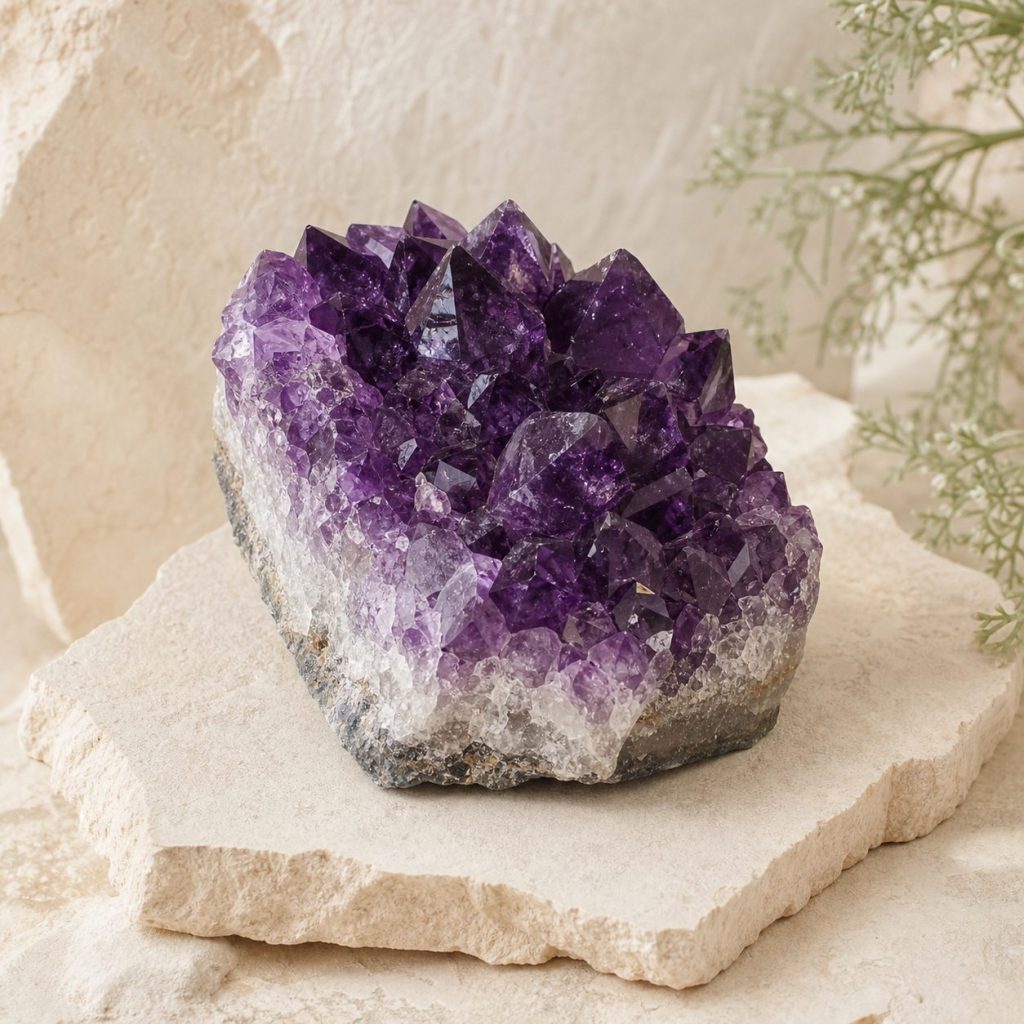
Not everyone wears jewellery. For nature lovers, collectors or people who “have everything”, a striking stone for the interior may be a better gift: an amethyst druse, a rock crystal sphere or a polished cut of petrified wood. You will find inspiration in the luxury decorations and stone products categories. We describe how to choose and place such a piece in our articles Minerals as Statement Pieces in the Modern Interior and Petrified Wood in the Interior.
Frequently asked questions
Which stone should I choose if I do not know what the recipient likes?
Go for versatile colours and a durable stone. Garnet, sapphire or aquamarine in silver or gold suits most wardrobes and can handle everyday wear. Earrings or a pendant are a safer choice than a ring.
Is gold-plated silver worse than gold?
It is not worse, it is different. Gold-plated silver has the look of gold at a significantly lower price, but the gold layer wears off over time with everyday wear. Jewellery made of 585 or 750 gold keeps its colour permanently and has a higher material value.
Why do two rings with the same stone cost completely different prices?
What matters is the size and quality of the stone (colour saturation, clarity, cut), the number and type of other stones and the metal. A silver ring with a cabochon and a gold ring with a cut stone of the same kind are in different price categories.
Is opal suitable as a gift?
Yes, it is just good to choose the right type of jewellery. Opal is softer and more sensitive to temperature changes, so it is better suited to a pendant or necklace than to an everyday ring.
Can I see the jewellery before buying?
Yes. Everything that is in stock in the e-shop is physically available at our store at Korunní 29a. You can look at the piece, compare it with others and get advice.
Before you choose
With jewellery featuring a natural stone, what matters is what a photograph conveys only halfway: how the stone works with light, how saturated its colour is in real life and how the piece feels in the hand. If you have the chance, stop by our store at Korunní 29a in Vinohrady. We will be happy to help you choose a piece to suit your budget, the recipient’s style and how often the jewellery will be worn. We will gift-wrap it for you on the spot.
If you are choosing from afar, call us on +420 601 555 226. We will be happy to send additional photos of specific pieces or provide further details.