Your cart is empty

Jewellery
Our range includes jewellery with natural gemstones: necklaces, rings, pendants, earrings and bracelets with rubies, sapphires, diamonds, moldavites, tourmalines, opals, tanzanites, pearls and dozens of other stones. Alongside the classic stones, we try to offer you unconventional minerals or unconventional forms of them – for example yellow, orange or pink sapphires alongside blue ones. Most of our jewellery is made of 925/1000 sterling silver, some of it of 585/1000 gold.
No products were found matching your selection.
How to choose jewellery with a natural stone
When choosing jewellery, the look of the stone matters, but so does how often and on what occasions you will wear it. Every stone can withstand something different, so it is worth knowing how durable it is.
Durability of the stone
Mohs hardness
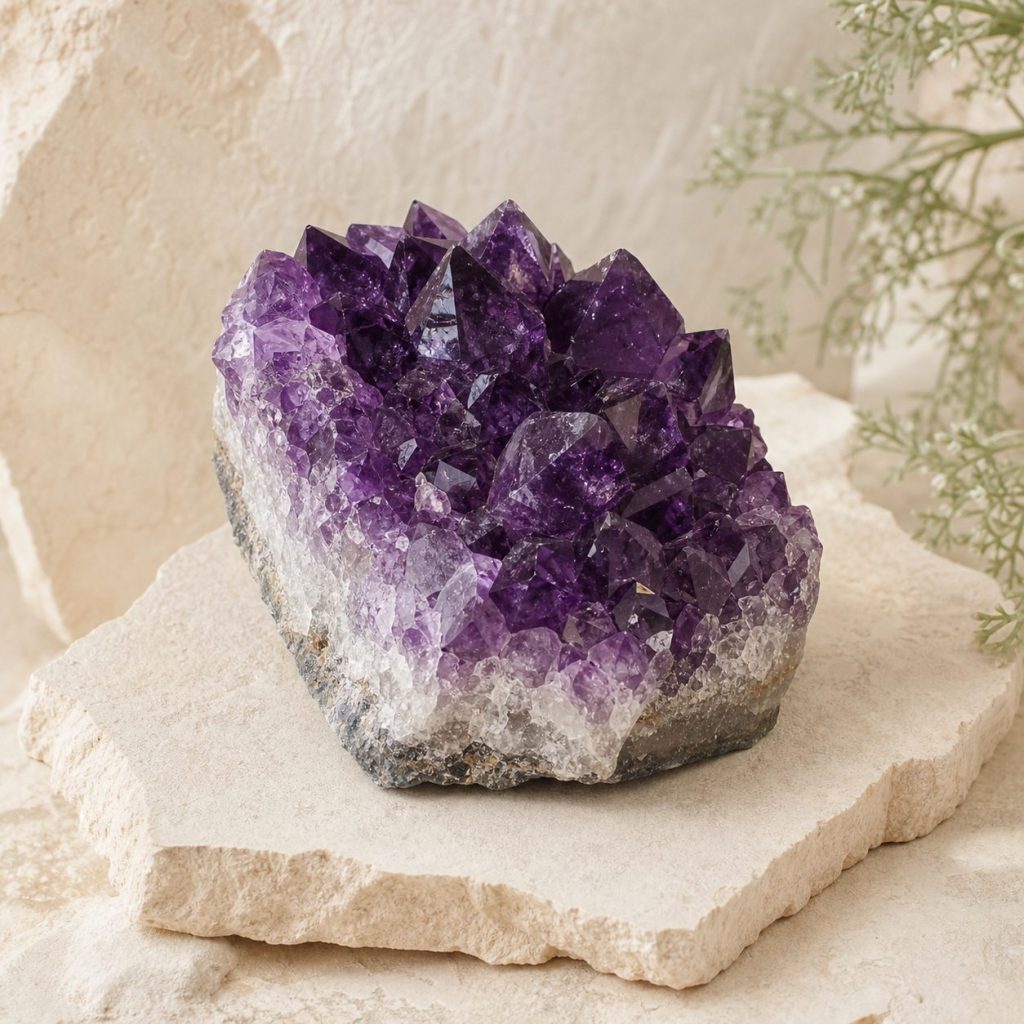
The hardness of a stone is measured on the Mohs scale from 1 to 10. Diamond has 10, ruby and sapphire (corundum) 9, topaz 8 and quartz – for example amethyst, citrine or rock crystal – 7. However, the scale is not linear. Diamond is many times more scratch-resistant than corundum, even though it is only one step higher on the scale.
Harder stones are better suited to a ring you wear every day. Softer stones are more suitable for pendants and earrings, which are less exposed to wear, or for jewellery for special occasions. Store your jewellery separately, as a harder stone can scratch a softer one – for example, a diamond will scratch a topaz.
Cleavage
Hardness is not the only physical property that determines the durability of a stone. Cleavage must also be taken into account – the tendency of a stone to split along crystallographically oriented planes. Fluorite, for example, breaks along the flat faces of an octahedron when struck. Stones with perfect cleavage are less resistant to impact than those without cleavage.
Chemical resistance
The mechanical durability described above is not the only factor determining the overall durability of a stone. Another key factor is its chemical resistance. Some fairly hard stones are not entirely suitable for everyday rings because they dissolve in acids, even mildly concentrated ones. Such solubility gradually shows, for example, with intensive washing of dishes.
Few people know that diamond, the hardest of all natural stones, will burn even in a candle flame. You need to protect your stone.
Inclusions
Stones containing numerous fluid inclusions (for example emeralds, opals or certain types of rock crystal) react strongly to changes in temperature; stress builds up inside them and they can crack or even shatter if, for example, you immerse them in hot water. These stones can react in the same way to ultrasonic cleaning. That is why they are recommended for rings for special occasions, and for earrings and necklaces, where they are not exposed to such risks.
Faceted, smooth or raw stones
Our range includes three ways of working a stone. Faceted stones are cut into facets that reflect light, making the stone sparkle. Smooth stones – cabochons and beads – show the colour and pattern of the stone, and with labradorite, moonstone or opal also its optical effects. Unworked stones retain the natural shape of the crystal or, thanks to their sculpted surface, are unique natural creations (for example moldavites or obsidians).
Silver or gold
Most of our jewellery is made of 925/1000 silver, an alloy containing 92.5% silver, traditionally known in English-speaking countries as sterling silver. Some pieces are made of gold-plated silver, i.e. silver covered with a layer of gold. Our gold jewellery is mainly 585/1000 (14 carat) and occasionally 750/1000 (18 carat). We state the fineness of the metal for every piece.
Jewellery by type
Necklacesbeaded necklaces and necklaces with a central stonePendantsfaceted stones and cabochonsRingswe state the ring size as the inner circumference in millimetresEarringsBracelets
Jewellery by stone
You can also choose jewellery by a specific stone:
Frequently asked questions
Are the stones in the jewellery genuine?
Yes, we offer natural stones, no synthetic substitutes. As mineralogists and experts, we take pride in offering you verified stones. If a stone has been treated in any way, we state this for the individual piece with a detailed description of the treatment. Feel free to ask us about the details of a specific stone.
Why does a piece of jewellery look slightly different in the photo than in real life?
The colour of a natural stone can look different depending on the lighting. Some stones, such as tanzanite, also show different shades from different angles. You can also see any piece of jewellery from our range at our store.
How do I find my ring size?
For every ring, we state the size as the inner circumference in millimetres. Measure the inner circumference of a ring that fits you well and compare it with the figure given for the product.
Who is behind the selection
The 4C Minerals range is selected by our mineralogist. You can see the stones and jewellery at our store at Korunní 906/29 in Prague’s Vinohrady district, where we will be happy to help you choose. You can also ask us about the details of a specific piece by phone or e-mail.