Your cart is empty

Minerals as Statement Pieces in the Modern Interior
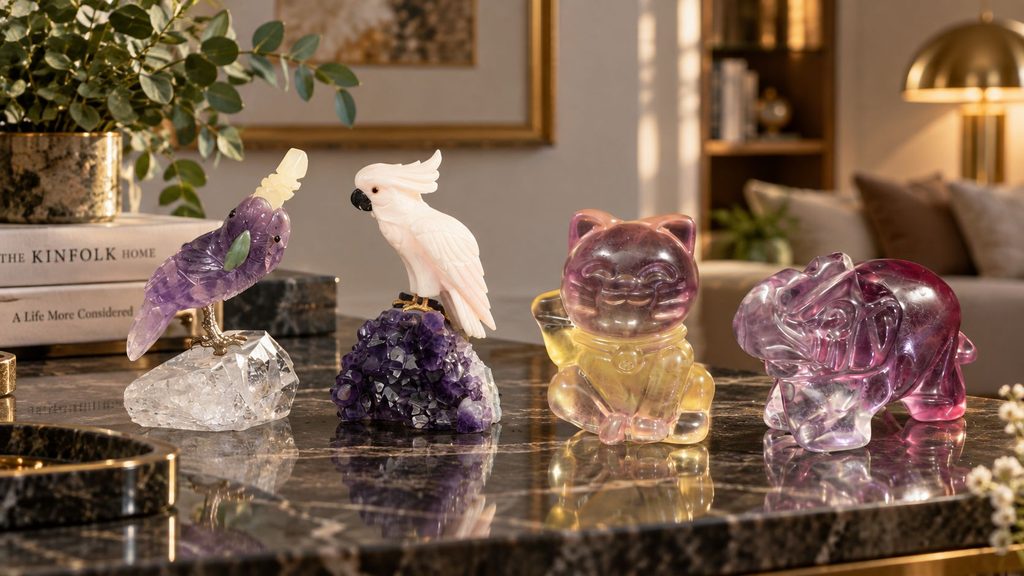
A large druse, geode or crystal sphere can work in an interior much like a sculpture or a striking work of art. What matters, however, is scale, placement, the stand and light — not the price of the stone itself. We take a practical look at how to choose a mineral statement piece that becomes a natural part of the space rather than looking like a random decoration.
The difference between a decoration and a statement piece is not just the price
Two amethyst pieces of similar value can look completely different in an interior. One gets lost among other objects, while the other naturally draws attention and visually anchors the entire wall. What matters above all is scale, placement, the stand, light and the amount of space the object is given around it.
The following guide therefore focuses on minerals as physical and design objects. It deals with their size, placement, lighting, combination with materials and practical properties — in other words, the things that determine whether a particular piece will really work in an interior.
A statement piece needs space
A statement piece is an object that has its own place in the composition and does not have to compete with a number of similarly striking objects. If you place several different minerals side by side, you get more of a collection — and while it can be just as valuable, it requires a different arrangement, such as a display cabinet, a regular rhythm or a systematic layout.
In an ordinary living space, a few simple principles therefore help:
- One dominant piece per clearly defined zone. Two can work just as well if they do not compete directly and each has its own visual space.
- If you want to work with several pieces, unifying them helps. Three objects of the same mineral in different sizes can look like a deliberate composition; several completely different stones side by side read more like a collector’s set.
- Leave empty space around the mineral. It is precisely the free space that lets you perceive its silhouette, structure and scale, and separates it from ordinary decoration.
What types of mineral objects work in an interior
Druse
A druse is a group of crystals grown on a common base and is one of the formats that best preserve the character of a natural find. Its irregular, jagged surface responds very well to side lighting. The crystal druses in our range cost from several thousand to tens of thousands of crowns; one example is this rock crystal druse.
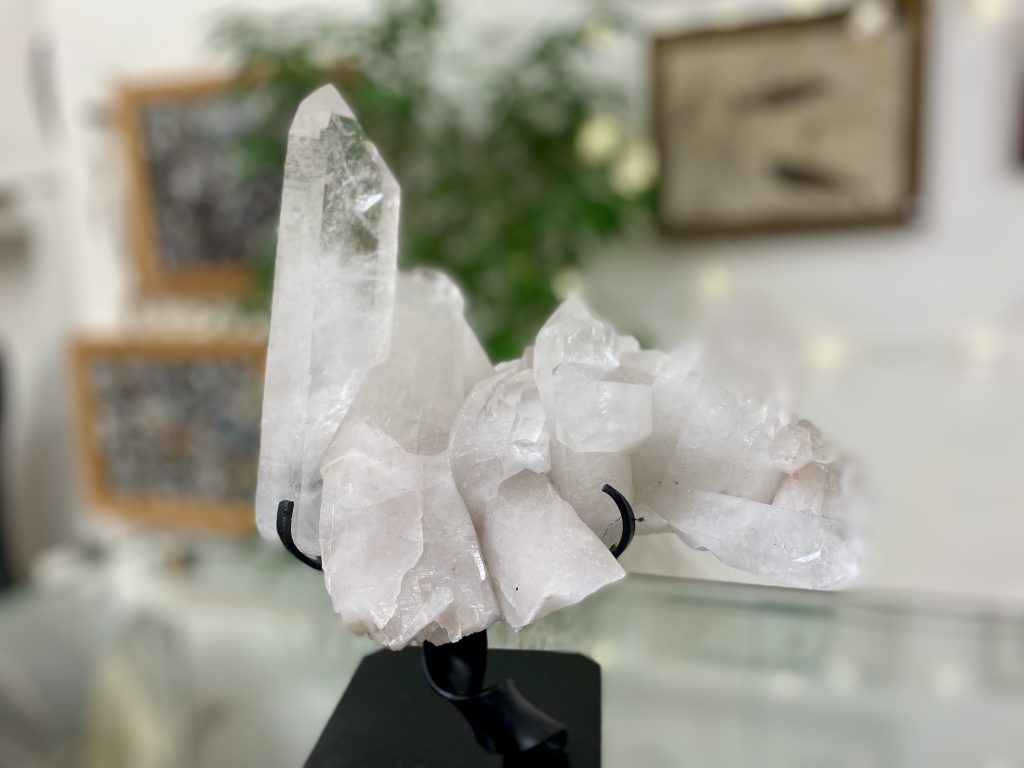
In an interior, a druse works well on a console table, a mantelpiece or a desk. It benefits most from directional side lighting, which highlights the individual crystals and their shadows.
Geode
A geode works with the contrast between an inconspicuous or rough exterior and the crystalline cavity inside. It is this transition that gives cut geodes their strong sculptural character.
Large geodes already belong to the same category as a free-standing sculpture. A giant amethyst geode with large glossy crystals and an unusual purple-brown colouring caused by fine inclusions of goethite, or a unique geode in the shape of a whale fin, are objects intended for the floor rather than for furniture.
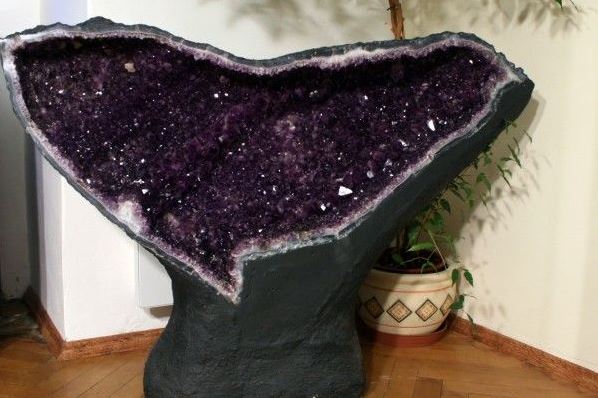
They work best against a wall, in a corner of the room, in an alcove or in an entrance hall, where they have enough distance around them and can be viewed from further away.
Sphere
A sphere, by contrast, is a very disciplined format. Its precise geometry creates a contrast with the irregular inner pattern of the stone, so it fits well even into minimalist interiors where a very jagged druse might look too expressive.
Once again, scale is decisive. A sphere eight centimetres in diameter is naturally a tabletop object, whereas a sixteen-centimetre rock crystal sphere already has considerably greater visual weight in the space. You will find other options in the Spheres subcategory.
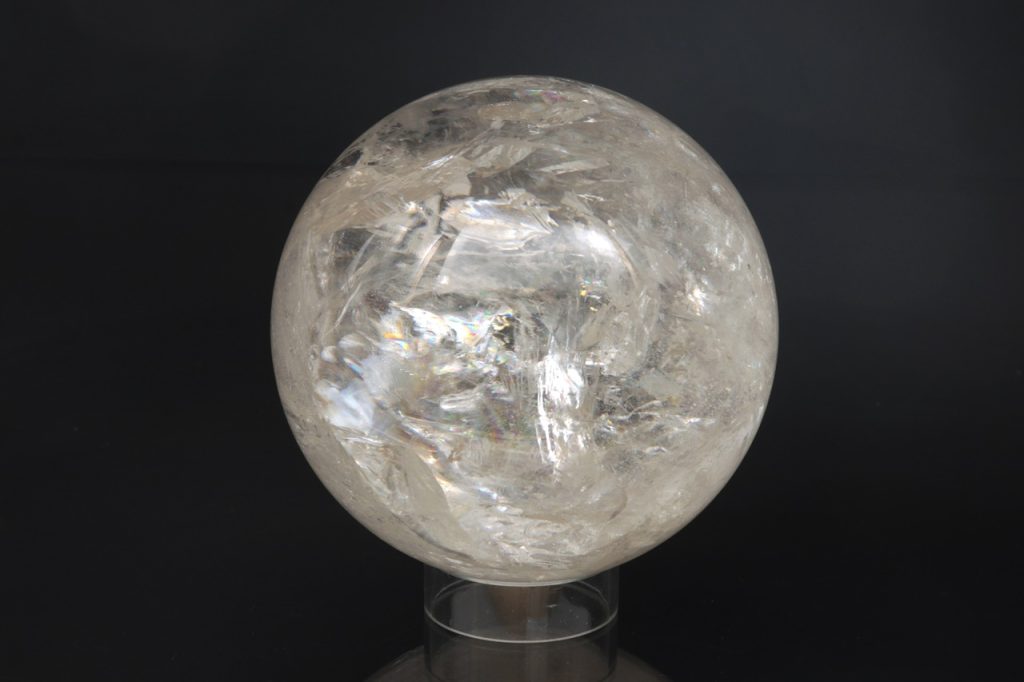
Transparent rock crystal spheres call for one practical precaution: in direct sunlight they can act as a converging lens and focus light into a small point. Therefore, do not place them on a windowsill or anywhere exposed to direct sunlight for long periods.
Lamps and backlit objects
Fluorite lamps make use of the translucency of the stone and its banded colouring. When switched on, they bring out structures and colour transitions that may not be as distinct in ordinary daylight.
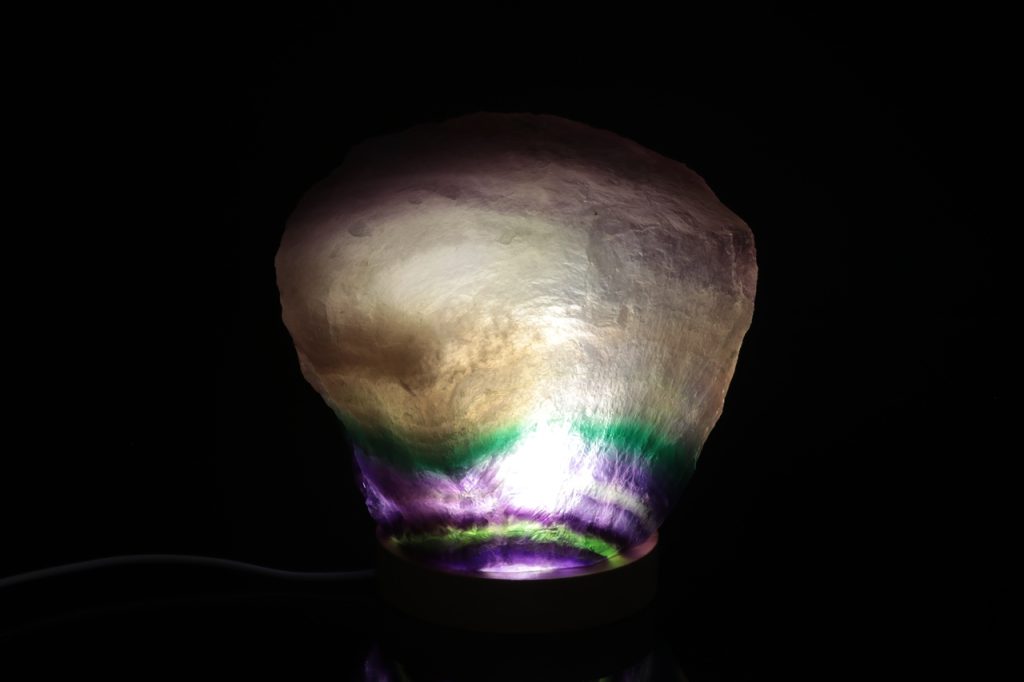
They suit a bedside table, a bookcase, a study or a bar. They work best as supplementary light and at the same time as a standalone object, not as the main light source of the room.
Slices and agate compositions
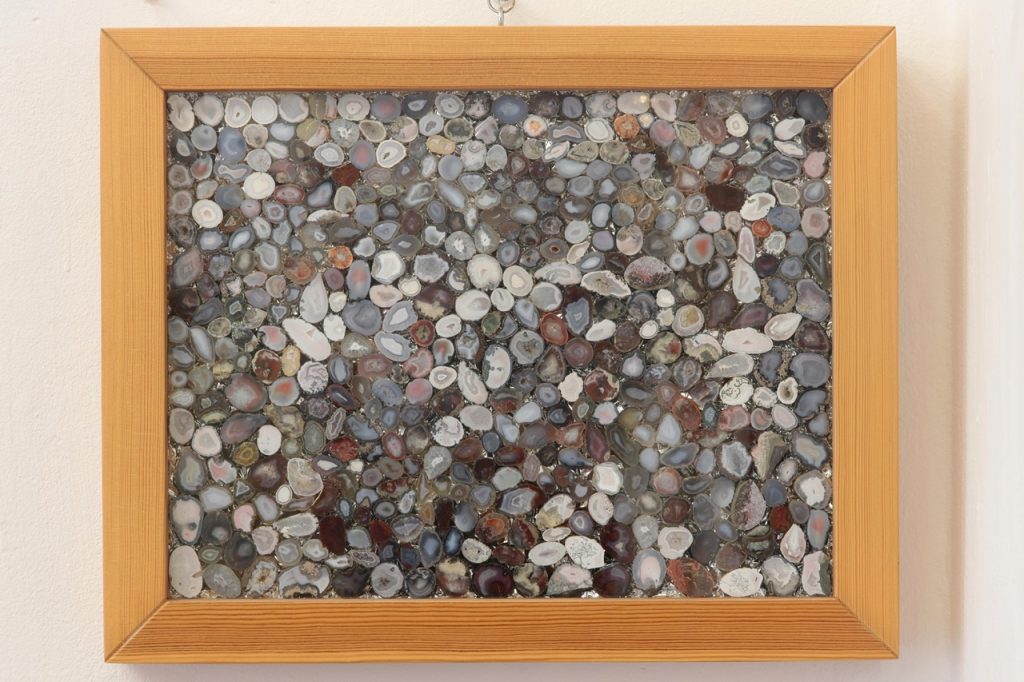
Agate slices on a stand as well as larger agate pictures make use of the translucency and concentric pattern of agate. They work well with controlled backlighting or against a light background; direct sunlight, however, is best avoided.
Functional objects
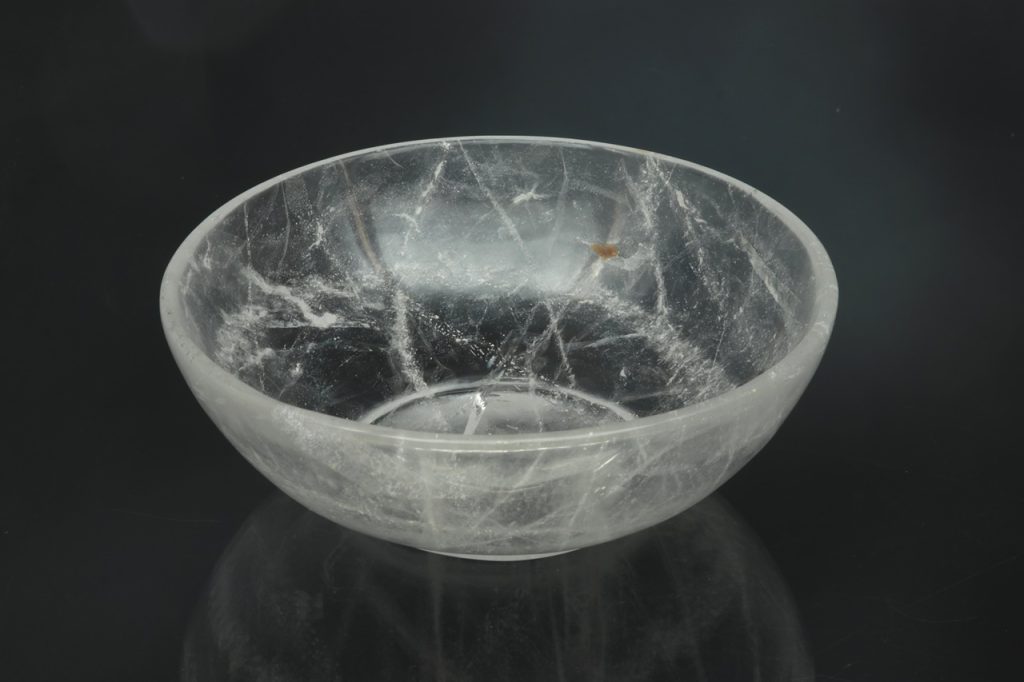
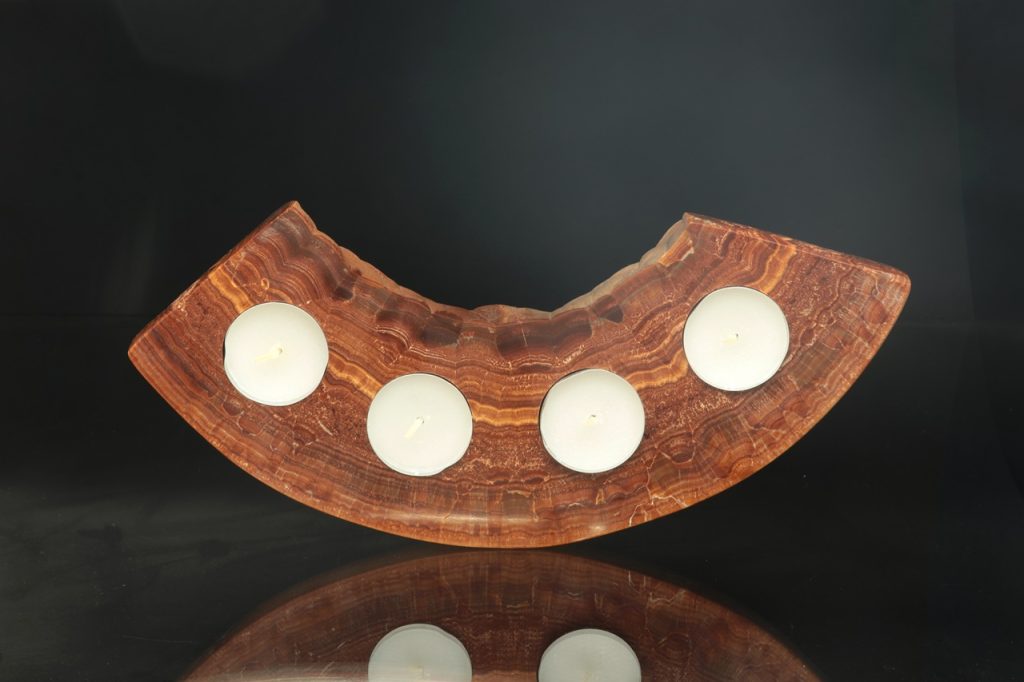
With bowls, goblets, candle holders or pyramids, the mineral becomes part of a functional object. A rock crystal bowl or an aragonite candle holder usually fits into an interior more easily than a large geological statement piece, because its function is immediately understandable.
Figurative pieces
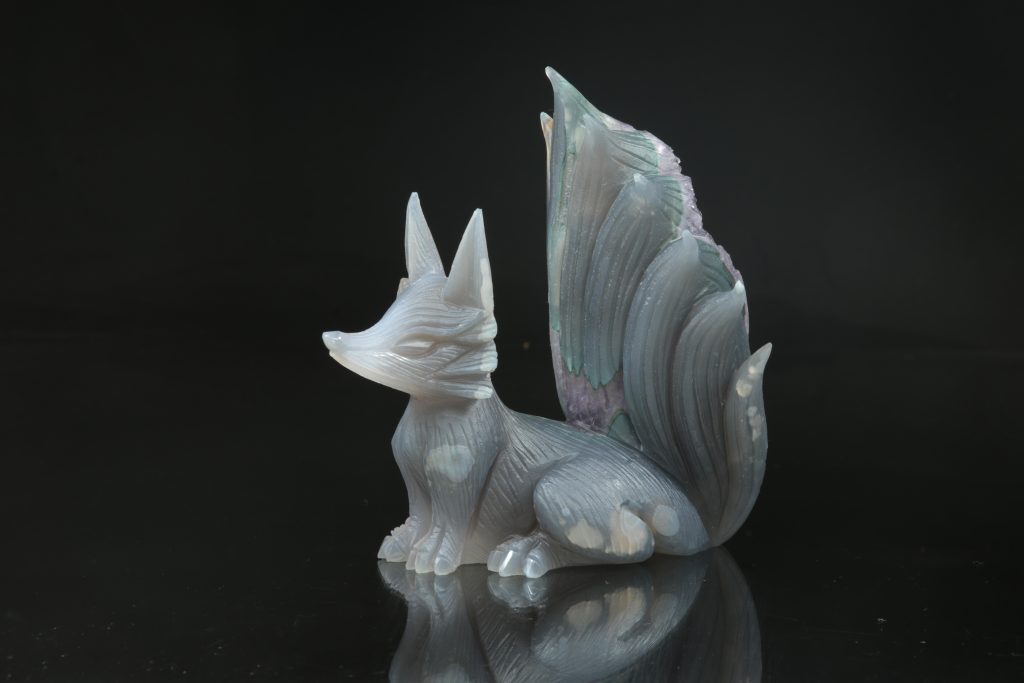
Figurative objects — foxes, elephants, skulls or turtles — place greater demands on the quality of workmanship and on placement. The more striking the shape itself, the more a simple setting and plenty of free space help. The advantage of agate foxes is that the natural banded pattern of the agate remains clearly legible and the figurative shape does not obscure it.
Scale matters more than it seems
One of the most common mistakes is choosing a piece that is too small for the space in which it is meant to work as the main object. A mineral may be high-quality and beautiful up close, but from a few metres away its structure and silhouette can easily get lost.
Three guiding principles can be used when deciding:
The rule of thirds. An object placed on a console table, a chest of drawers or a mantelpiece should have sufficient scale in relation to the surface. As a rough guide, you can count on a height of approximately between one third and one half of the width of the surface, or on the object taking up roughly a third of its length.
The distance rule. The place from which you most often look at the mineral also matters. From five metres away, an object 30–40 cm tall will be more legible than a fifteen-centimetre druse whose detail is almost lost at that distance.
The viewing angle rule. We usually look at a coffee table from above, so spheres, slices and polished surfaces stand out well there. Console tables or shelves, on the other hand, are viewed almost head-on, which suits druses and open geodes better.
Where to place a mineral — and which places to avoid
Places that work particularly well are those where the object has enough space and is not exposed to unnecessary mechanical or thermal stress:
- A console table or chest of drawers in the entrance hall — the mineral can work here as the first striking object a visitor sees.
- A mantelpiece — a naturally defined horizontal surface, provided it is not exposed to high temperatures when the fireplace is in use.
- A separate shelf in a bookcase — ideally with plenty of empty space around the object, not squeezed between books.
- A corner of the room or the space by a wall — suitable for large geodes and other floor-standing statement pieces.
- A desk — for a smaller sphere, a polished cut or a small druse that can be observed up close.
- A bathroom niche — depending on the specific mineral and its resistance to moisture, you can work with rock crystal or agate, for example.
On the other hand, caution is advisable in the following situations:
- Walkways and narrow corridors. A jagged or heavy stone can be impractical and prone to knocks in a space where people frequently walk past it.
- Direct sunlight. Amethyst, rose quartz and some fluorites can gradually lose their saturation with long-term exposure to UV radiation. For striking pieces, a position right next to a south-facing window is therefore not suitable.
- The immediate vicinity of a radiator or a fireplace in use. Repeated heating and cooling creates thermal cycles that can stress material with internal tension.
- Within reach of small children. With lighter or unstable pieces, the possibility of them being knocked over must be taken into account; crystalline surfaces can also have sharp edges.
- Permanently humid environments for minerals with iron components. Pyrite, for example, can oxidise and gradually degrade under long-term exposure to moisture.
The stand as part of the composition
A stand is often an inconspicuous part of the whole, but it can significantly change the way we perceive a mineral. It lifts the object above the surrounding surface, separates it from the furniture and can at the same time adjust its stability and viewing angle.
Its role is therefore threefold: to set the mineral apart in the space, to stabilise it safely and to position it so that its pattern or crystal face stands out best.
| Stand | Character | Suits |
| Clear acrylic | Disappears, the stone seems to float | Minimalist interiors, small pieces |
| Black metal, matte | Graphic, sharp contrast | Industrial, modern style |
| Brass | Warm, luxurious | Classic and Art Deco interiors |
| Dark wood | Natural, soft transition | Scandinavian and Japandi style |
| Stone or concrete | The object blends with the base | Large pieces, brutalist spaces |
In general, a stand that is visually simpler than the stone itself works best. A highly ornamental or overly decorative stand can easily start competing with the mineral for attention.
For large geodes over 30 kg, the stand is also a safety element. The centre of gravity may be high and the contact surface surprisingly small, so in a household with children or pets it is advisable to address stability and possible fixing individually.
Lighting: light is part of how a mineral is presented
A mineral that looks dark and flat under ordinary general lighting can gain striking depth under well-directed light. Druses reveal shadows between the crystals, polished surfaces show reflections and translucent materials display layers of colour that otherwise remain hidden.
Three techniques by type of piece
Side light at a sharp angle (grazing light). Suitable for druses, geodes and other jagged surfaces. Light directed almost parallel to the surface creates small shadows on the individual crystals and emphasises the relief. As a guide, the source can be placed 30–50 cm from the piece and slightly above it.
Backlighting or lighting from below. Suitable for translucent materials such as agate slices, fluorite, selenite or thin cuts. A hidden source behind or beneath the object brings out the colour layers and internal structures.
Soft light from above. With spheres and polished objects, the aim is depth, lustre and controlled reflection rather than emphasising relief.
Colour temperature and type of light
- 2700–3000 K (warmer light) works well with amethyst, citrine, agate, rose quartz or carnelian and enhances warm as well as purple tones.
- 3500–4000 K (more neutral light) is suitable for rock crystal, selenite, calcite or fluorite if you want to preserve their cleaner colour rendering.
- Very cold light above 5000 K tends to look less natural in a living interior and can shift the overall impression towards exhibition or retail lighting.
LED sources with low heat output and no significant UV component are suitable. For directional lighting, a narrower beam angle, for example 15–24°, is usually more useful than a wide spread. Halogen sources generate more heat and are less suitable for more sensitive minerals.
Dimming is also practical. The same object may need stronger accent lighting during the day, while in the evening it usually looks better at a lower intensity.
Combining with other materials
A mineral has its own distinctive structure, lustre and colour, so it benefits from surroundings that do not compete with it unnecessarily.
It combines well with matte wood, such as oak, walnut or ash, with concrete and plaster finishes, linen and coarser textiles, brass, smoked glass or dark metal.
More caution is advisable with very glossy surfaces, strongly veined marble, heavily patterned wallpaper or other dominant minerals in the immediate vicinity. Two striking materials at close range can compete instead of complementing each other.
The colour of the background is also important. Pale rock crystal, selenite or white calcite become more legible against a darker surface, while obsidian, shungite or black agate need a lighter contrast. Amethyst tends to be more versatile and often works well against a warm neutral wall.
How to recognise a piece that will hold its own in an interior
- It has a clear visual focal point — a striking crystal, a continuous surface or a legible silhouette. The composition does not feel fragmented among several equally strong elements.
- The shape and the joining of the individual parts look natural. With geodes, it pays to inspect the transition between the crystalline part and the base; an unnaturally straight seam or traces of glue may indicate that it has been assembled afterwards.
- The colouring corresponds to the material. Electric blue, very bright pink or rainbow agates are often dyed. Natural agate usually comes in a more muted palette.
- The polishing supports the natural structure instead of covering it up completely. Pieces combining one polished surface with a surface left raw can be particularly striking.
- The size corresponds to the intended place and viewing distance. With a statement piece, scale is just as important as the quality of the mineral itself.
- The stand is simple, or not needed at all. Its task is to help the stone, not to become a second decorative element.
- The origin and method of processing are known. Information about the locality, the mineral and any treatments is among the basic details of a quality piece that the seller should be able to document or explain.
What to watch out for when choosing
Dyed agates are among the common treatments on the market. Unnaturally saturated shades, such as electric blue, purple or turquoise, are suspicious, as are cases where the colour is strongly concentrated in the porous layers and disappears in the denser parts.
Geodes with crystals attached afterwards – with a suspicious piece, inspect the bottom edge and the transition between the crystalline part and the matrix; a straight seam or visible filler may indicate tampering.
Irradiated rock crystal offered as natural smoky quartz – natural colouring is usually less uniform, whereas heavily irradiated pieces can be very evenly dark to black.
Synthetic or glass material passed off as natural rock crystal – with perfectly clear spheres, it is advisable to look for internal features. Natural rock crystal often contains inclusions, phantoms or healed fractures.
Care and maintenance
- Remove dust with a soft brush or a vacuum cleaner with a brush attachment and reduced suction. With druses, wiping the surface with a cloth is not advisable, as fabric catching between the crystals can damage them.
- Minerals that are resistant can be washed with lukewarm water, a soft brush and, if necessary, a small amount of neutral soap. Selenite, halite and other water-soluble minerals, however, should only be cleaned dry.
- Avoid ultrasonic cleaners for pieces with internal cracks, as well as hot water, acidic products and aggressive chemicals. The cleaning method should always be adapted to the specific mineral.
- When handling large pieces, lift them by the solid matrix or base, not by individual crystals.
- Do not expose minerals to sudden changes in temperature. For example, a stone brought in from the frost should not be rinsed with warm water straight away.
Budget levels
| Budget | What you can get |
| up to CZK 3,000 | Smaller spheres, agate slices on a stand, pyramids, small figurines |
| CZK 3,000 – 15,000 | Quality druses, fluorite lamps, medium-sized spheres, agate pictures, polished cuts |
| CZK 15,000 – 60,000 | Large rock crystal spheres, striking druses, large polished objects, rock crystal bowls |
| over CZK 60,000 | Giant geodes, museum-quality statement pieces — floor-standing pieces that carry the entire space |
Browse our luxury decorations, decorative stones and stone products to get a more complete picture of our range.
Frequently asked questions
How large a mineral do I need for a living room?
For an object on a console table or chest of drawers, you can count on a height of approximately 25–45 cm as a guideline. A floor-standing statement piece usually starts at around 60 cm and more. Smaller pieces have a more natural scale on a desk, a bedside table or in a bookcase.
Does amethyst really fade in the sun?
Yes. Long-term exposure to intense sunlight can cause amethyst to fade gradually. The change is slow and, under normal conditions, cannot easily be reversed.
Can I place a mineral on underfloor heating?
We do not recommend it for striking or more valuable pieces. Constant heating from one side creates a temperature gradient in the material and, with stones that have internal tension, can increase the risk of cracking.
How can I tell if a geode has been glued?
Focus on the transition between the crystalline filling and the outer shell. In a natural geode it is usually irregular and gradual. A straight seam, visible filler or other traces of parts being joined are, on the other hand, suspicious.
Does every mineral need a stand?
No. Geodes with a stable base and large druses can stand on their own. A stand is more essential for spheres, eggs or pieces with a small contact surface. Even where it is not technically necessary, however, it can help with the viewing angle and with separating the object from the surrounding surface.
Why it makes sense to choose in person
With mineral statement pieces, seeing them in person is very valuable. A photograph shows the colour and basic shape, but it conveys less well the true scale, the depth of the crystals, the lustre and how the object changes as the viewer moves.
At our store at Korunní 29a in Vinohrady, the pieces on display are physically available. If you are choosing a mineral for a specific place, bring a photograph of the interior and the dimensions of the surface. It is then much easier to judge proportions, colour and the type of stand.