Your cart is empty

Precious, Fire or Pink Opal? How They Differ, How to Recognise a Genuine One and How to Care for It
Opal is one of the few commonly used gemstones that do not have a crystalline structure. Its characteristic play of colour is not caused by an admixture, but by the diffraction of light on tiny spheres of silica. At the same time, a single name covers stones that are alike neither in appearance nor in price. We explain how precious, fire and common opal differ, how to tell a genuine stone from a synthetic one, an imitation or a doublet, and how to care for opal jewellery so that it lasts.
Three opals on one necklace
Our precious and fire opal necklace is a good starting point. On a single strand there are clear and milky beads of precious opal, honey-coloured transitional tones and deep red beads of fire opal. All of them are opals, and yet a layperson would most likely take them for three different stones.
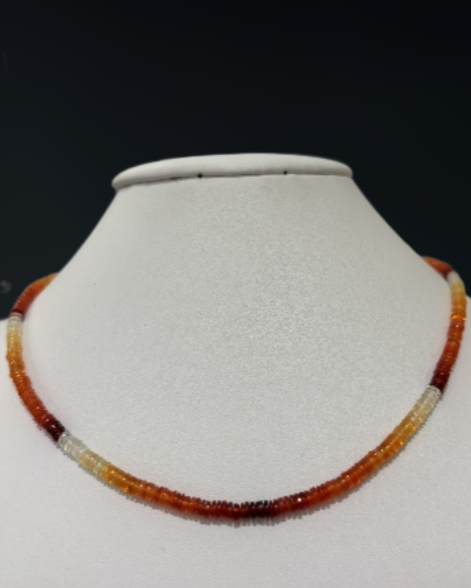
This is exactly what makes opal tricky. The name on its own says almost nothing about the stone. For value, appearance and care, what matters is what type of opal it is, where it comes from and whether it is entirely natural.
A stone that is not a crystal
Most gemstones are crystals with regularly arranged atoms. Opal is not. It is amorphous, i.e. non-crystalline silica with a variable water content. Its formula is written as SiO₂·nH₂O and, according to GIA, water can make up roughly 20% of its mass. Because it has neither a fixed chemical composition nor a crystal structure, mineralogy classifies it as a so-called mineraloid.
Opal forms where water containing dissolved silica penetrates cavities and cracks in rock. When the water evaporates during a dry period, the silica is deposited and gradually solidifies.
Where the play of colour comes from
In precious opal, the silica is deposited in the form of tiny spheres with a diameter of roughly tenths of a micrometre, stacked in a regular lattice. Light passing through the gaps between them is diffracted and split into the colours of the spectrum. The size of the spheres determines which colours you see: spheres of around 0.1 µm produce violet, spheres of around 0.2 µm red. That is why opals with red flashes are rarer than opals that play mainly in blue and green.
This phenomenon is technically called play of colour (play-of-color), and it is precisely what distinguishes precious opal from common opal. Do not confuse it with opalescence, the milky, bluish sheen that opals without play of colour also have.
The three basic types of opal you will encounter most often
| Precious opal | Fire opal | Common opal (e.g. pink) | |
|---|---|---|---|
| Play of colour | Yes, it is its essence | Often weak or none | No |
| Body colour | White, grey, black and clear | Yellow, orange, red | Pink, yellow, blue, green… |
| Typical cut | Cabochon | Often a faceted cut | Beads, cabochons |
| Best-known deposits | Australia, Ethiopia | Mexico | Peru (pink) |
| Jewellery in our range | from CZK 4,150 | from CZK 1,450 | from CZK 890 |
Precious opal
Precious opal is classified by the body colour against which the play of colour takes place. White (light) opal has a light, milky body and is among the most common. Black opal has a dark body on which the colours stand out the most, and is therefore usually the most valuable. Crystal opal is transparent to translucent, and boulder opal is cut together with a piece of the surrounding rock, so the rock is part of the finished stone.
White precious opals with rainbow flashes predominate in our range. You will find them, for example, in a ring with an oval 13 × 8 mm cabochon in 925/1000 silver for CZK 5,790, in a smaller ring with a 10 × 8 mm cabochon for CZK 4,570 or in a pendant with an Ethiopian opal in 585/1000 gold for CZK 8,800. Anyone who wants opal around the neck without a prominent pendant can choose a necklace of cut precious opal beads for CZK 12,990. The beads are graduated from 8 mm in the centre to 6 mm at the clasp. You will find all jewellery with precious opal in the precious opal category.

Fire opal
You can recognise fire opal by its body colour, not by its play of colour. It is transparent to translucent and its body is yellow, orange or red. Its play of colour tends to be weak or absent altogether. The most important deposit is Mexico, which produces stones of the richest and purest shades. Because fire opal does not rely on play of colour, it is often faceted like other transparent gemstones.
Our range includes, for example, a pendant with a fire opal cabochon in an orange-brown shade for CZK 1,450 or a fire opal necklace for CZK 2,300. More in the fire opal category.

Common opal: pink, yellow and others
Common opal has no play of colour, but that does not mean it is less beautiful. It is simply assessed differently, according to the saturation and evenness of its colour. The best known is pink opal, whose most important deposits are in Peru. Mineralogically, Peruvian pink opal is a mixture of opal with other minerals, and according to research its colouring is caused, among other things, by organic substances from the quinone group and other components.
Common opal is the most affordable. For example, a pink opal pendant costs CZK 890 and a yellow opal necklace of faceted beads CZK 1,680. A pink opal necklace with graduated 5–7 mm beads for CZK 4,900 comes from Peru. A more striking piece is the necklace of large pink opal beads 11 mm in diameter for CZK 6,300. You will find the full range in the opal category.

Where opals come from
For more than a hundred years, Australia supplied the vast majority of the world’s production of precious opal. The most valuable black opals also come from there. The expression “Australian” has therefore become associated with opal, although today it is far from true that every quality opal comes from Australia. Our range includes, for example, a loose oval cabochon of Australian precious opal weighing 3.1 ct (15.2 × 9.9 mm) for CZK 2,000, suitable for a collection or as a stone for your own jewellery. You will find more among our cut gemstones.
Ethiopia is the second major source. Precious opals from there began to reach the market in 1994, and the decisive breakthrough came with the discovery of a deposit in the Wollo (Welo) province in 2008. Ethiopian opals tend to have a very striking play of colour and are generally cheaper than Australian opals of comparable quality. The opals in our pendants for CZK 4,150 and CZK 4,400, for example, come from Ethiopia. Most Ethiopian opals, however, are hydrophane: they are porous and readily absorb water, which has consequences for their care (see below).
Mexico is the most important source of fire opals, and Peru is known mainly for pink and blue common opal.
A curiosity from our part of Europe: long before Australia, the most famous European source of precious opal was the mines near Dubník and Červenica in eastern Slovakia. Because of how the monarchy was organised at the time, opal from there was sold as “Hungarian”. The mines enjoyed their greatest heyday in the 19th century. Australian opal gradually began to compete with them, and mining ended after the First World War; by 1922 Czechoslovakia could no longer afford it.
How to recognise genuine opal
There is more confusion surrounding opal than most other stones. Besides natural opals, four categories are sold on the market, and it is good to distinguish between them.
1. Synthetic opal. It has been produced since the 1970s and has essentially the same chemical, physical and optical properties as natural opal. Its play of colour can look very convincing, but its price is significantly lower. An experienced gemmologist can often recognise it under a loupe or microscope by the overly regular structure of the colour patches. Some pieces, however, require a laboratory test.
2. Imitations. Glass, resin or plastic that merely imitate opal. Beware of the name opalite: it is a trade name for glass with a milky bluish sheen, not a type of opal. An imitation must be clearly labelled as an imitation.
3. Doublets and triplets. A thin layer of genuine precious opal glued onto a dark backing (doublet), possibly also covered with a transparent cap of quartz or another material (triplet). The dark backing makes the play of colour stand out, so a doublet can look like a much more expensive black opal. There is genuine opal in it, but only in a thin layer. It is given away by the glued seam when viewed from the side. If the stone is set in a closed bezel that covers the side, you will not see the seam, and then the only way is to ask the seller.
4. Treated opals. Porous Ethiopian opal can be artificially darkened with smoke or dye to resemble black opal. Opals are also impregnated with oil, wax or plastic. Treatment in itself is not fraud if it is disclosed, but it significantly lowers the price.
What this means when buying: ask whether the opal is natural, solid and untreated. With us, stones are identified by mineralogists and geologists, and the opals in our jewellery are natural, with no synthetic stones. If needed, we can document the identification of the stone with a mineralogical analysis or an expert report.
Opal in jewellery: what it is suited for
Opal has a hardness of 5–6.5 on the Mohs scale, i.e. less than the quartz in ordinary dust. Its toughness, i.e. resistance to chipping and cracking, is poor to fair according to GIA. In practice, this means:
- Pendants, earrings and necklaces are ideal for opal because they are not exposed to knocks.
- An opal ring is fine for occasional wear. Take it off when working with your hands, doing sport or cleaning. Cabochons in a bezel setting, which protects the edges of the stone, are safer.
- Durability depends on the specific stone, i.e. on its water content, internal fissures and locality. For Ethiopian opals from Wollo, for example, gemmologists have described fire and crystal pieces as being more prone to cracking than opaque white ones.
If you are choosing an opal as a gift, our article A Gift with a Genuine Stone: How to Choose Jewellery That Lasts for Generations will also help you.
Caring for opal
- Heat and sudden changes in temperature. Opal does not tolerate heat or rapid changes in temperature. Strong light that warms the stone can cause a fine network of cracks. Do not leave it in the sun behind a window, in a car in summer or near a radiator, and do not wear it in the sauna.
- Chemicals. Opal is attacked by strong alkaline solutions. Apply cosmetics and perfume before putting the jewellery on, and take it off before cleaning with cleaning products.
- Cleaning ordinary non-hydrophane opal. For ordinary non-hydrophane opal, GIA recommends lukewarm water with mild soap and a soft cloth as the only safe method.
- Do not soak hydrophane (mostly Ethiopian) opal. Absorbed water can temporarily change its transparency and appearance and, in exceptional cases, can even lead to cracks. A dry or only slightly damp soft cloth is enough.
- Never soak doublets and triplets. Water can damage the glued layer.
- Never use an ultrasonic cleaner or steam cleaning.
- Storage. Store opal separately, ideally in a soft pouch. Harder stones in other jewellery could scratch it.
What determines the price of opal
With precious opal, the main factor is the play of colour: how intense it is, which colours it contains (red tends to be the rarest and most highly valued), how large an area it covers and what pattern it has. Another factor is the body colour: black opals are generally the most expensive, white the most affordable. Size, solidity (solid opal vs. doublet), the presence of cracks and origin also play a role.
With fire opal, the saturation and purity of the colour and transparency are decisive. With common opal, it is mainly the colour, its evenness and the quality of workmanship.
Indicative price levels for jewellery based on our current range:
| Type of jewellery | Price range |
|---|---|
| Common opal (pink, yellow) | approximately CZK 890 – 6,300 |
| Fire opal | approximately CZK 1,450 – 3,900 |
| Precious opal in silver | approximately CZK 4,150 – 12,990 |
| Precious opal in gold | approximately CZK 8,800 – 23,500 |
Frequently asked questions
Is opal suitable for an engagement ring?
For a ring that is worn every day and never taken off, opal is not ideal, because it is softer and more fragile than sapphire or diamond. If you want an opal, be prepared to take the ring off when working with your hands, and choose a cabochon in a bezel setting that protects the edges of the stone.
Why did my opal become transparent in water?
It is most likely a hydrophane opal, typically Ethiopian. It absorbs water and, after soaking, its transparency can change temporarily. After slowly drying at room temperature, it usually returns to its original state. Do not dry it with a hairdryer or on a radiator.
Is opalite an opal?
No. Opalite is a trade name for glass that imitates opal. Apart from its appearance, it has nothing in common with natural opal.
How can I recognise a doublet?
Look at the stone from the side. With a doublet, a straight glued seam is visible between the thin layer of opal and the dark backing. If the side is covered by a metal bezel, ask the seller.
Can opal crack on its own?
A quality, stable opal should not crack spontaneously with normal handling. The risks are mainly sudden changes in temperature, intense heat, impact and, with some stones, drying out. That is why you should not leave opal in direct sunlight or near a heat source.
Opal needs to be seen in motion
Play of colour can only be partially captured in a photograph. The colours of precious opal change with every turn, and one stone can look completely different from different angles. If you have the chance, come and see the opals at our store at Korunní 29a in Vinohrady. You can look at the stones under different lighting, compare precious, fire and pink opal side by side and get advice on care. We will also be happy to send you additional photos or a video of specific pieces from the e-shop.