Your cart is empty

Tanzanite: A Stone from a Single Deposit in the World. How to Choose a Ring or Necklace and How to Care for It
Tanzanite is one of the youngest gemstones on the market. Just sixty years ago it was not known as a gemstone, and to this day it is commercially mined in only one place in the world. It captivates with its rich blue-violet colour, which changes with the viewing angle and with the light. We explain where tanzanite comes from, why almost every stone has been heat-treated, what determines its quality and price, whether it is suitable for a ring and how to care for it.
A gemstone that no one knew sixty years ago
In 1967, a Maasai herdsman found blue-violet crystals in the Merelani area in northern Tanzania. He pointed them out to a local gem prospector, Manuel d’Souza, who registered the first four mining claims at the site. Within a short time, another ninety were established on the same territory of roughly 50 km².
The stone was named by Tiffany & Co., which became its main distributor. It named it after its country of origin and launched it on the market in 1968 with a major advertising campaign.
Mineralogically, tanzanite is the blue-violet variety of the mineral zoisite. It is commercially mined in only one place in the world, the Merelani area near Kilimanjaro. It is precisely this uniqueness of the locality that is part of its appeal.
Tanzanite is also one of the stones associated with December, making it a natural choice for December birthdays or as a Christmas gift. You will find tips on choosing a gift in our article A Gift with a Genuine Stone: How to Choose Jewellery That Lasts for Generations.
Why tanzanite changes colour
Tanzanite is strongly pleochroic: viewed from different directions, it shows different colours. For untreated tanzanite, the technical literature describes three colours: reddish violet, deep blue and yellowish green. The cutter must therefore orient the stone so that the desired colour stands out when viewed from above. Cutting for pure blue costs more rough material than cutting for blue-violet, and this is one of the reasons why pure blue stones are more expensive.
Light also affects the colour of tanzanite. Cooler daylight emphasises blue, while warmer artificial light shifts the stone towards violet. The very same ring can therefore look like a sapphire by the window and like an amethyst under a lamp in the evening. When choosing, it is worth looking at the stone in both types of light.
Heat treatment: common and stable
Most of the mined material tends to be brownish or has a yellowish-green component. Routine heating removes it and emphasises the blue and violet colour. This treatment is standard for tanzanite, is stable and, according to GIA, does not affect the durability of the stone. Heat-treated tanzanite is therefore the normal state, not a defect.
Other treatments are rare, but it is good to know about them:
- Surface coatings (coating) that change the colour. They are not permanent and can be scratched or rubbed off.
- Fracture filling. It is unusual for tanzanite, and the filler can change over time.
Also beware of the names “green tanzanite” or “pink tanzanite”. Zoisite also occurs in green and pink, and sellers sometimes label these stones that way. Gemmologically, however, they are correctly green and pink zoisite. Tanzanite is only the blue to violet variety.
What determines quality and price
There is no standard quality grading scale for tanzanite. GIA does not grade tanzanite; in its reports it only describes weight, shape, cut, colour and detectable treatments. Designations such as “AAA” that you may come across are sellers’ own classifications and cannot be compared between shops.
In reality, value is determined by four properties:
1. Colour. Saturated blue to violetish-blue stones are valued most, but strongly violet stones can also be of high quality, and many people prefer an intense blue-violet. Lighter pastel shades are more common and therefore more affordable.
2. Size. With tanzanite, size and colour are closely related. Small stones tend to be lighter, and a rich, deep colour usually only appears in larger stones, often around 5 carats and above. So if you want a striking colour in a small piece of jewellery, expect the stone to be medium to lighter in tone.
3. Clarity. Faceted tanzanite is usually free of inclusions visible to the eye. Value is reduced mainly by fissures that threaten the durability of the stone.
4. Cut. A well-cut stone distributes light evenly across its entire surface. A poorly cut one looks dull or has dark or light “dead” areas.
Faceted stone or cabochon?
In our range you will find tanzanite in both forms, and each has a different character.
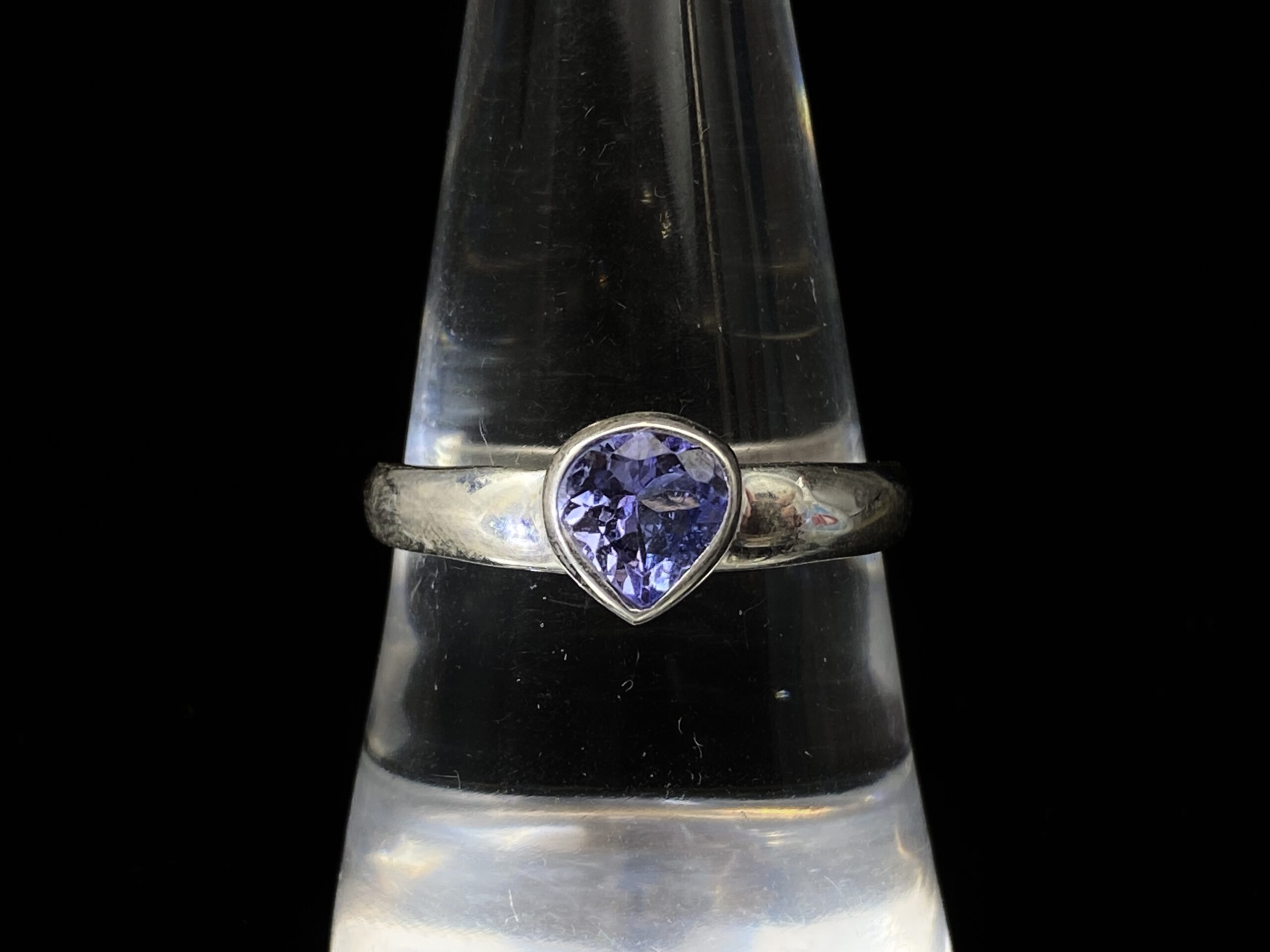
Faceted tanzanite sparkles, and as it moves its pleochroism shows itself in flashes of different shades. Examples are a ring with a square 4.5 mm faceted tanzanite in 925/1000 silver for CZK 4,200 or a ring with a 5.5 × 6 mm faceted pear in a violet shade for CZK 4,890.
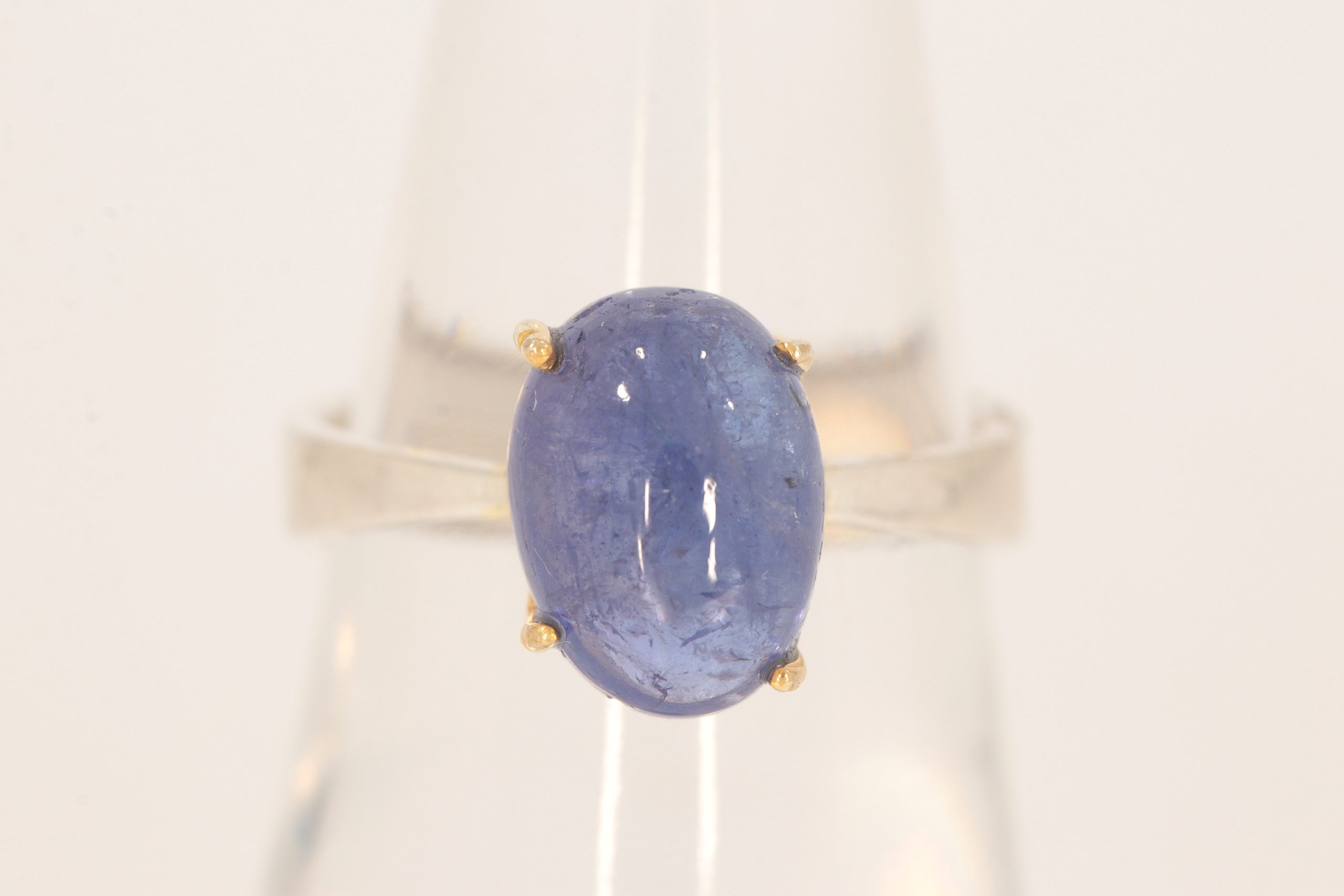
A cabochon, i.e. a smoothly polished stone with a domed surface, shows the depth and saturation of the colour and has no sharp facet edges, which are more sensitive to knocks. Examples are a ring with an 11 × 8 mm cabochon in a rich blue-violet shade, in partially gold-plated silver, for CZK 5,000, or a pendant with a 14 × 10 mm pear-shaped cabochon for CZK 1,609. A larger pendant with an oval 15 × 11 mm cabochon costs CZK 2,760.
Ring or necklace?
Tanzanite has a hardness of 6–7 on the Mohs scale, so it is considerably softer than sapphire (9). According to GIA, its toughness is fair to poor, and tanzanite has distinct cleavage, so a hard blow can split it along its cleavage planes.
A tanzanite ring is therefore great for occasional wear and for going out. If you want to wear it every day, take it off when working with your hands, doing sport and cleaning. Stones in a bezel or a protective setting that shields their edges are safer. Tanzanite rings in our range start at CZK 3,300.
A necklace is ideal for tanzanite because it is not exposed to knocks. You can choose, for example:
- a tanzanite and rose quartz necklace for CZK 3,300,
- a necklace of smooth tanzanite beads that increase in size from roughly 5.5 mm to 1 cm in the centre, length 45.2 cm, for CZK 7,900,
- a necklace of faceted tanzanite beads in blue and violet tones, graduated from 3 to 8 mm, length 57 cm, for CZK 12,700.

You will find the full range in the tanzanite jewellery category.
Caring for tanzanite
- Cleaning: lukewarm water with mild soap and a soft brush or cloth.
- Never use an ultrasonic or steam cleaner. GIA explicitly advises against them for tanzanite.
- Temperature: protect it from high temperatures and sudden changes in temperature.
- Chemicals and light: under normal conditions it is stable to light and common chemicals, but it should not come into contact with aggressive acids.
- Storage: store it separately. Sapphire, ruby or diamond in other jewellery can scratch it.
How much tanzanite costs
The price depends mainly on size, colour saturation, cut and metal. Indicative price levels based on our current range:
| Type of jewellery | Price range |
|---|---|
| Pendants with a cabochon | approximately CZK 1,600 – 2,800 |
| Rings | approximately CZK 3,300 – 5,000 |
| Necklaces | approximately CZK 3,300 – 12,700 |
Frequently asked questions
Why does tanzanite look different at home than in the shop?
Because of the light. In cool daylight tanzanite looks bluer, in warm incandescent light more violet. This is a natural property of the stone, not a defect.
Is heat-treated tanzanite inferior?
No. Heat treatment is standard for tanzanite, is stable and does not reduce the durability of the stone. The vast majority of tanzanites on the market are heat-treated.
Is tanzanite suitable for an engagement ring?
It can be, but you need to bear in mind that it is softer and more fragile than sapphire or diamond. If a tanzanite engagement ring is to be worn often, choose a protective setting and take the ring off when working with your hands.
What is green or pink tanzanite?
Gemmologically, it is correctly green or pink zoisite. Tanzanite is only the blue to violet variety of zoisite.
Is tanzanite rare?
It is commercially mined in only one area in the world, in Tanzania. Large stones of a deep blue colour are particularly rare. Smaller and lighter stones are available at reasonable prices.
Tanzanite needs to be seen in two kinds of light
With tanzanite, a photograph does not capture the most essential thing: how the colour changes between blue and violet depending on the light and viewing angle. If you have the chance, come and see the tanzanites at our store at Korunní 29a in Vinohrady. You can look at the stone in both daylight and artificial light and choose the shade that suits you. We will be happy to send you additional photos of specific pieces from the e-shop.