Your cart is empty

Petrified Wood in the Interior: When a Tree Millions of Years Old Becomes a Design Object
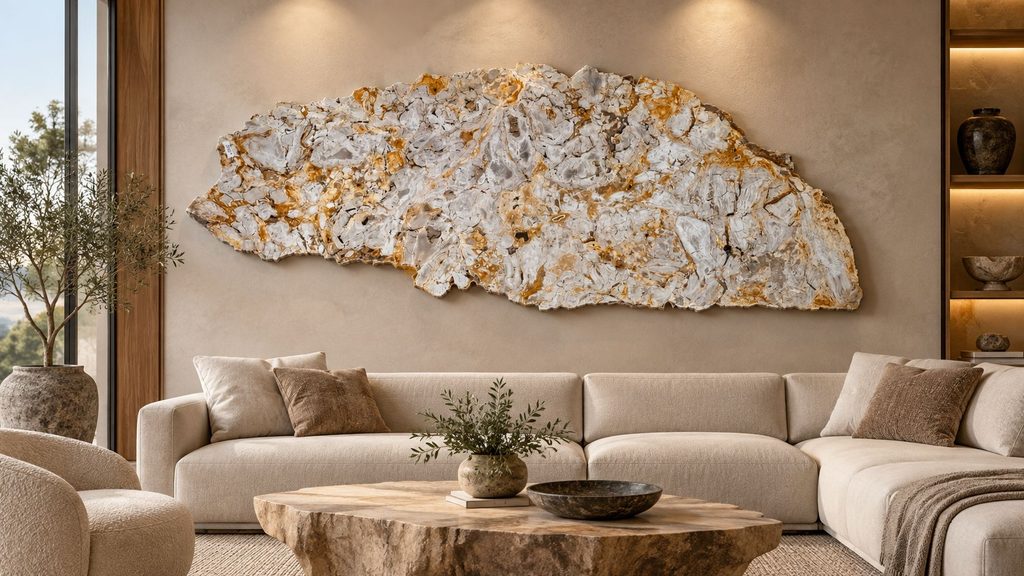
Petrified wood combines a geological story with a striking visual character: the structure of an ancient trunk remains legible, but the original organic matter has been replaced by minerals. In the interior, it can therefore work as a standalone piece, a table top or a wall object. We look at how it forms, what to consider when choosing a specific piece and what to think about when it comes to placement, mounting and lighting.
A tree that outlived its own death by millions of years
A slab measuring 257 × 94 centimetres and weighing around 280 kilograms. The growth rings are legible down to the last detail, the surface is polished to a mirror finish, and the colours range from white through grey and beige to brownish-black tones. At first glance it looks like wood. In fact, it is opalised wood whose original structure was mineralised mainly by opaline silica.
This is what one of the pieces in the Petrified sequoia slabs category looks like. It is also a very good example of why petrified wood is no longer seen merely as a geological curiosity and appears more and more often in homes, receptions and architecturally designed commercial spaces.
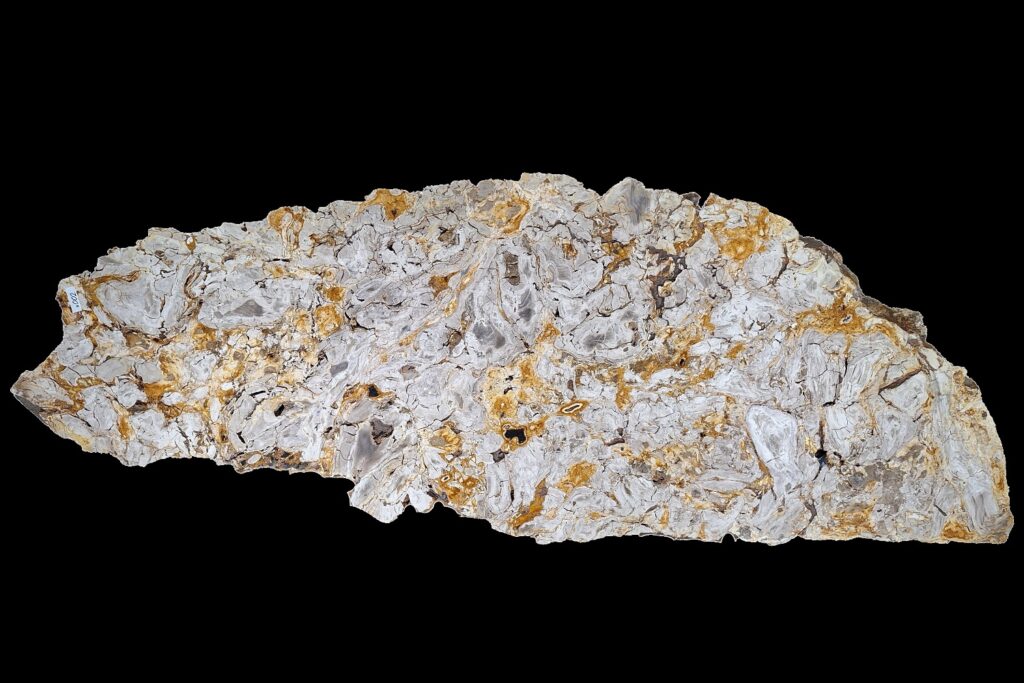
Its impact rests on an unusual contradiction. The eye still recognises wood – growth rings, bark, knots and the natural pattern of the trunk. Touch, however, reveals stone: cool, hard and heavy. It is precisely this combination of a familiar organic structure with the properties of a mineral that gives petrified wood its exceptional visual power. A well-chosen piece can therefore work as the single dominant object in a room.
How a tree actually turns to stone
Petrified wood does not form simply by drying out or ageing for a long time. It is a mineralisation process in which the original organic matter is gradually replaced by minerals. Descriptions of how it forms most often mention permineralisation and the subsequent replacement of the original wood tissue.
The basic condition is rapid burial of the trunk, for example under flood sediments or volcanic ash. This limits access to oxygen and the activity of organisms that would normally decompose the wood. Groundwater with dissolved silica then penetrates the microscopic pores of the wood and fills them with mineral matter. Mineral substances fill the pores and cell structures of the wood and, during further fossilisation, can gradually replace the original organic matter as well. The process can preserve even very fine details – from growth rings to the structure of the bark – except that they are no longer made of cellulose but of mineral matter.
Silica can be deposited in various forms: as opal, the hydrated amorphous form, as chalcedony, jasper or crystalline quartz. Different mineralisation conditions are one of the reasons why petrified wood from different localities differs in colour, pattern and overall character.
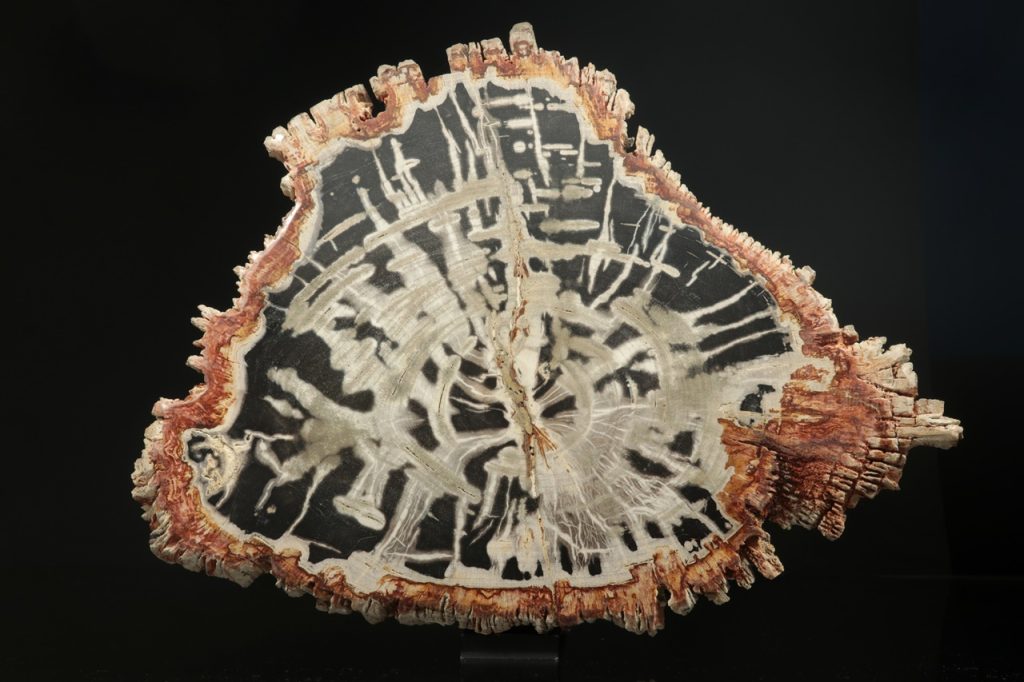
Pure silica is colourless. The colours come from other mineral and carbonaceous components trapped during fossilisation, especially compounds of iron and manganese and other trace elements. The result can be red, ochre, purple, grey or almost black tones. In a slice through a trunk polished on both sides with a striking black-and-white pattern, the colouring is mainly due to manganese oxides and organic carbon.
For use in the interior, hardness and weight also matter. The physical properties depend on the mineral that replaced the wood. Petrified wood consisting mainly of chalcedony or quartz reaches a hardness of about 6.5–7 on the Mohs scale and a density close to that of quartz. Opalised wood is softer and lighter; opal itself has a hardness of about 5–6.5 and a specific gravity of around 2.15. A slab five centimetres thick with an area of about 2.5 m² can therefore weigh almost 300 kilograms. With large formats, this weight must be taken into account as early as the placement design stage.
Where it is found and why origin matters
Petrified wood cannot be understood as a single material with a uniform appearance. Individual finds come from different geological periods and localities, and it is precisely their origin that strongly influences their colours, structure and physical properties.
Arizona, Chinle Formation. One of the best-known localities in the world. The petrified wood here comes from the Late Triassic Chinle Formation. The individual layers in the area of today’s Petrified Forest National Park formed roughly 208 to 225 million years ago. Striking red, orange and purple tones are typical. Collecting within the national park itself is prohibited, so legally traded material comes from surrounding private land.
Chemnitz, Germany. The Permian petrified forest here is about 291 million years old and is known for the exceptionally good preservation of plant structures, down to the cellular level.
Northern Hungary. This is also where the opalised sequoia slabs in our range come from. According to the descriptions of the individual pieces, they are Tertiary sequoias from a volcanic area: after dying, the massive trunks were buried in mud and volcanic ash and then permeated by silica from mineralised thermal solutions, which was deposited in their structure as opal. The result is compact, solid slabs with a very clearly legible wood pattern.
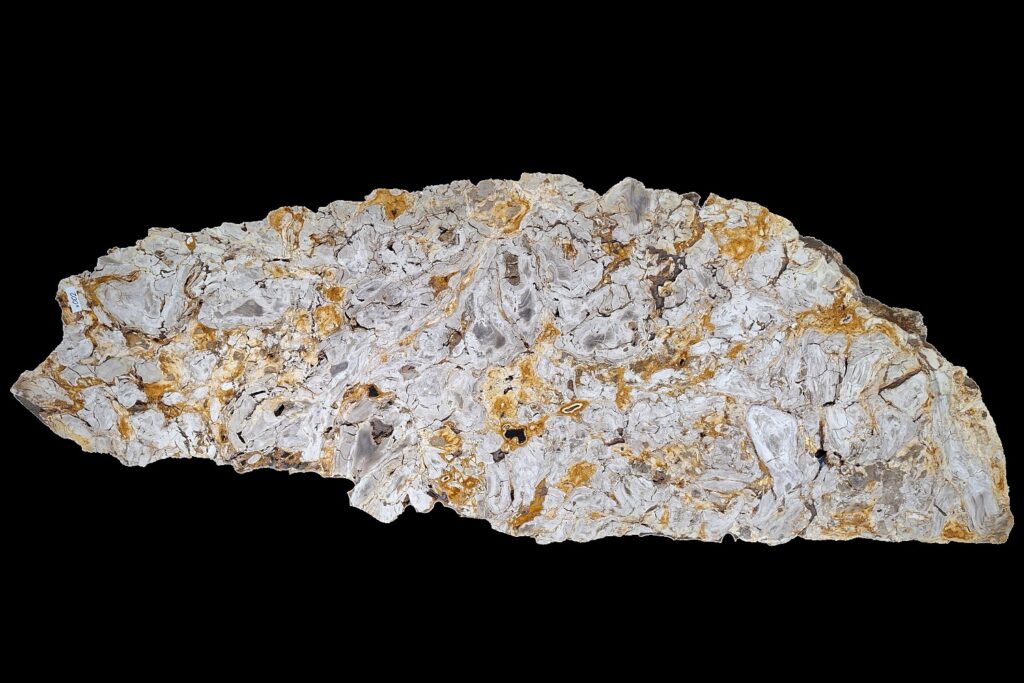
The information about origin is therefore not just an interesting detail in the product description. It helps explain the colour palette, the degree to which the original structure is preserved and the mechanical properties of a specific piece.
Why petrified wood works in contemporary interiors
Contemporary interior design gives plenty of room to natural materials, irregularity and original objects that are not the result of mass production. Petrified wood combines all three qualities and adds one more that is hard to imitate: geological time, which is literally legible in the material.
Besides this story, however, petrified wood also has a number of purely practical advantages:
A muted palette. Most pieces work with beige, white, grey and brown tones. This makes them easy to combine with light oak, dark walnut, polished concrete and other neutral materials.
Structure instead of pattern. The growth rings and the pattern of the trunk are organic, yet clear and legible. In the interior they therefore bring detail and depth without having to be distracting.
Durability. The mineralised material does not move like ordinary wood and reacts far less to normal changes in humidity. Its mineral colouring is generally very stable under normal interior use.
Originality. Every cut comes from a specific trunk and has its own pattern, cracks and colour transitions. It is therefore not a limited series of similar pieces but a genuine original.
Four formats and what they are suited to
Polished slice (cross-section of a trunk)
A polished cross-section of a trunk is one of the most affordable formats. It usually has a diameter of about 20–40 cm, a thickness of 2–3 cm and weighs up to a few kilograms. On a simple stand it works well on a console, shelf or desk. In the decorative stones category, prices for these pieces start at roughly a few thousand Czech crowns.
It is suitable where you want to bring the character of petrified wood into the interior, but a large slab does not make sense in terms of space or price.
Large polished slab
With large polished slabs, the scale changes. A cut with an area ranging from tens of centimetres to several metres is no longer a small decoration but an architectural element. It is most often used as a coffee or dining table top, or as a wall object replacing a painting.
The sequoia slabs in our range go from formats suitable for a small side table up to the 257 × 94 cm mentioned above. Prices range roughly between CZK 25,000 and CZK 150,000 depending on size, how well the pattern is preserved, colouring and finish.
Raw piece with a cut and polished face
An interesting in-between option is a piece with one face cut and polished while the rest remains in its original rough form. It retains the character of a geological find while offering a surface on which the pattern of the material stands out. It works well, for example, in combination with dark wood, metal or concrete.
Smaller statement pieces and branch fragments
Smaller fragments and parts of branches are suitable for a bookcase, desk or chest of drawers. They have a more intimate scale and let you appreciate the material up close and hold it in your hand. In terms of price, they are the easiest way into this category.
How to choose: seven practical criteria
1. Scale in relation to the space. A piece that is too small is easily lost in a large room. A 25 cm slice on a three-and-a-half-metre console, for example, will not work as a statement piece. As a rough guide, the object should take up about a third of the length of the surface it stands on.
2. Preservation of the pattern. What matters most for the appearance is how legible the original wood structure is: growth rings, bark, knots or branching. Two pieces of the same age may have similar geological value, but the one in which the original pattern is clearly recognisable will be far more impressive in the interior.
3. Quality of the polish. The surface should be even, without dull spots or visible grinding marks. With slabs polished on both sides, it makes sense to inspect both sides; the pattern and quality of finish may differ.
4. Natural cracks. Cracks are part of the character of the material and do not in themselves have to mean a defect. In some high-quality slabs they are deliberately not filled with resin, to preserve the original appearance. With larger cracks, however, it is advisable to ask about the stability of the specific piece and how it should be supported.
5. Colour in relation to the space. A cool grey piece will behave differently in the interior than a slab with a warm brown or red edge. A photo of the wall, floor and main pieces of furniture will help when choosing.
6. Thickness and weight. With table tops, you need to find a balance between mechanical strength and weight. A cut that is too thin is more sensitive to handling, while a thick slab significantly increases the demands on the base and the floor.
7. Consider the weight when choosing. With large pieces, it should be one of the first figures you check. It affects transport, carrying the piece into the building, the type of base and any requirements on the load-bearing capacity of the structure.
Structural loads, mounting and practical placement
With large-format slabs, an aesthetic decision very quickly becomes a technical question as well.
Table top. With an ideally even distribution of weight, a 280-kilogram slab resting on four separate legs would transfer about 70 kg to each leg; in reality, the load may vary depending on the design and the position of the centre of gravity. A standard base from living-room furniture is not designed for such a load. A solid metal base with a large contact surface, or a stone or concrete structure, is more suitable. It is advisable to place a suitable resilient pad between the stone slab and a hard base to limit direct contact between hard materials and help compensate for small irregularities.
Floor. With floating floors or lighter ceiling structures, it is advisable to spread the weight over a larger area. In older buildings, especially those with wooden beam ceilings, it is sensible to consult a structural engineer about placing very heavy pieces. What matters is not only the total weight but also the size of the contact area, the design of the base and where the load sits in relation to the load-bearing elements.
Wall mounting. For lighter slabs, appropriate anchoring into a load-bearing wall can be used. As the weight increases, a steel frame transferring the load into the load-bearing structure is a safer solution. For heavy pieces, you should not rely on plasterboard or a non-load-bearing partition; the anchoring method should be designed and carried out by a professional.
Transport and delivery into the building. Before ordering a large slab, measure not only the doors but also the lift, the staircase and the space needed to turn the piece. For slabs weighing hundreds of kilograms, planning also includes the number of people and the equipment needed for safe handling.
Lighting
Large slabs and most decorative pieces of petrified wood behave practically as an opaque material in the interior, so you work mainly with incident and reflected light. The way you light them should depend on whether you want to emphasise the surface structure or the depth of the polished surface.
Side light at a sharp angle (grazing light). A spotlight positioned so that the light falls almost parallel to the surface brings out fine relief and the pattern of the growth rings. This approach is particularly effective with wall-mounted slabs.
Soft light from above. For table tops and highly polished surfaces, softer light is usually more suitable, as it enhances the depth of the surface and its natural sheen without creating distracting sharp shadows.
The colour temperature of the light can be based on the colouring of the specific piece: about 2700–3000 K for beige and brown tones, 3500–4000 K for cool grey and black-and-white slabs. LED sources with low heat output and without a significant UV component are suitable.
Care
In a normal interior, petrified wood is an undemanding material. Care focuses mainly on gently removing dust and dirt and on limiting sudden temperature changes.
- Dust: a soft dry cloth or brush; for textured surfaces, a vacuum cleaner with a brush attachment on the lowest setting.
- Grease and fingerprints on polished slabs: lukewarm water with a drop of neutral soap, then wipe dry immediately.
- Do not use acidic cleaners (vinegar, descalers), abrasives or steam cleaners.
- Do not expose it to sudden thermal shocks – a hot pot placed directly on a cold slab can cause stress at the site of a crack.
- Ordinarily polished decorative pieces generally do not need any further waxing or sealing; for table tops, follow the recommendations for the specific material and surface finish.
With normal use, petrified wood is therefore very durable. The greatest risk is a mechanical impact or a fall, especially at natural cracks.
How much petrified wood costs and what affects the price
The price is influenced mainly by the size and area of the cut, how well the original structure is preserved, the colouring and the level of finish. With exceptionally large or aesthetically striking pieces, these factors multiply each other.
Indicative price levels based on our current range:
| Format | Price range |
| Smaller slices and fragments | a few thousand CZK |
| Medium polished cuts (30–40 cm) | roughly CZK 5,000 – 30,000 |
| Large sequoia slabs | roughly CZK 25,000 – 150,000 |
You will find the current pieces and their prices in the decorative stones category and among our luxury decorations.
Frequently asked questions
How can I tell genuine petrified wood from an imitation?
Genuine petrified wood has a much higher density than ordinary wood, and its physical properties correspond to the minerals it is made of. Quartz and chalcedony pieces reach a hardness of about 6.5–7 on the Mohs scale; opalised wood tends to be softer. A conchoidal fracture may appear on a fresh break, and in well-preserved pieces the original cell structure can be seen under a magnifying glass.
Can petrified wood withstand water?
Yes. The silicate material withstands water in normal contact. More attention should be paid to aggressive cleaning agents, deposits and sudden temperature changes.
Will it fade in the sun?
The colouring of petrified wood is linked to mineral components enclosed in the quartz or opal matter, not to organic pigments. When placed normally in an interior, it therefore does not fade in the way typical of some coloured minerals, for example.
Can a slab be made into a functional dining table?
Yes, provided the base, support and weight are properly resolved. For a large dining table top, it is advisable to involve a joiner, a metalworker or, depending on the situation, a structural engineer, and to make sure the stone is not fixed rigidly without any possibility of minimal movement.
Is petrified wood suitable for a bathroom?
Yes. Normal air humidity does not harm the material itself. In practice, however, it is advisable to avoid places with a constant direct stream of water, where mineral deposits would quickly form on the surface.
Before you choose a specific piece
With petrified wood, seeing it in person is particularly useful. A photo shows the pattern well but conveys the real scale, weight and depth of the polished surface less well. We have the slabs and smaller pieces physically available at our store at Korunní 29a in Vinohrady, where you can also discuss their size, placement and mounting.
If you are choosing a piece for a specific project – for example a table top, a wall object or a statement piece for a precisely defined space – it is worth bringing the dimensions and a photo of the interior. Based on them, the selection can be narrowed down in advance to pieces that make sense in terms of proportions, weight and colouring.